
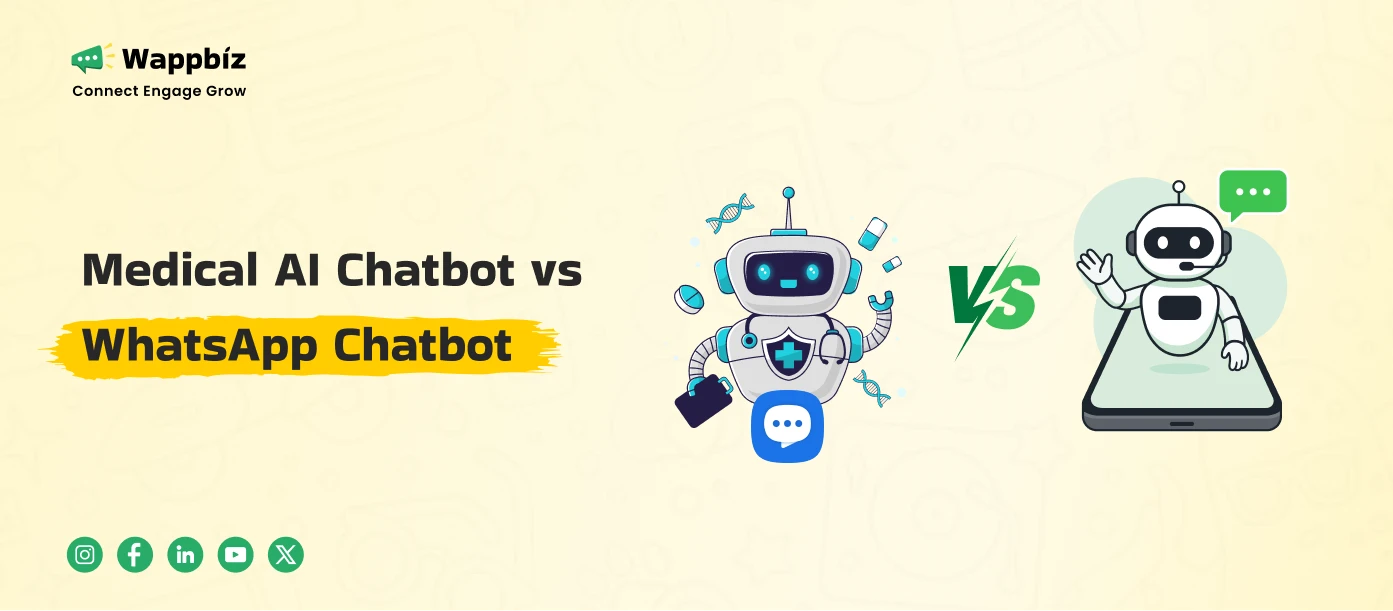
Healthcare is finally catching up with technology and the conversation has moved beyond whether to use chatbots, to which chatbot is right for your hospital. Two options dominate the discussion: Medical AI Chatbots and WhatsApp Business Chatbots. Both are powerful. Both are being adopted rapidly. And both serve very different purposes.
If you’re a hospital administrator, CTO, or healthcare marketer trying to make this decision, this guide breaks it all down without the jargon.
What Is a Medical AI Chatbot?
A Medical AI Chatbot is a purpose-built conversational AI designed specifically for clinical or health-related tasks. These tools integrate directly with Electronic Health Records (EHR), Hospital Information Systems (HIS), and other healthcare infrastructure to assist in diagnostics, treatment guidance, patient intake, and care coordination.
Common use cases include:
• Symptom checking and preliminary triage
• Clinical decision support for doctors and nurses
• Chronic disease monitoring and management
• Post-operative care follow-up
• Prescription and medication reminders
Medical AI chatbots are typically accessed through a hospital’s own app, web portal, or integrated interface, not a third-party messaging platform.
What Is a WhatsApp Business Chatbot?
A WhatsApp Business Chatbot is an automated conversational bot deployed on WhatsApp via the WhatsApp Business API. Hospitals and clinics use it to communicate with patients directly on an app they already use every day reaching over 500 million users in India alone.
Common use cases include:
• Appointment booking and reminders
• OPD queue updates and slot availability
• Discharge summaries and prescription sharing
• Lab report delivery and follow-up
• Health tips, vaccination alerts, and awareness campaigns
• Insurance queries and billing FAQs
The WhatsApp chatbot doesn’t replace clinical systems; it sits in front of them, handling patient communication at scale, 24/7, in the patient’s own language.
Medical AI Chatbot vs WhatsApp Chatbot
| Parameter | WhatsApp Chatbot | Medical AI Chatbot |
| Primary Use | Patient engagement, triage, reminders, FAQs | Clinical decision support, EHR integration, diagnostics |
| Setup Complexity | Low uses existing WhatsApp accounts | High requires deep hospital system integration |
| Cost | Affordable; scales with usage | Enterprise pricing; significant implementation cost |
| Patient Adoption | Very high patients already use WhatsApp | Moderate requires staff and patient onboarding |
| Channel | WhatsApp (mobile messaging) | Web portals, EHR systems, dedicated apps |
| Data Security | Complies with WhatsApp Business policy | Built for HIPAA/healthcare compliance by design |
| Best For | Patient-facing communication at scale | Clinical workflows, diagnosis support, care teams |
| Languages Supported | Multiple WhatsApp supports 60+ languages | Depends on vendor; varies widely |
| Response Time | Instant (24/7 automated) | Instant to near-instant depending on integration |
| Customisation | High flows, templates, integrations | High but complex and costly to change |
Where WhatsApp Chatbots Win
1. Patient Reach and Adoption
The biggest challenge in healthcare communication isn’t technology, it’s getting patients to actually use it. WhatsApp requires a zero learning curve. Patients already have it installed. You’re meeting them where they are, not asking them to download another app or log in to another portal.
2. Appointment Management at Scale
Missed appointments cost hospitals lakhs every month. A WhatsApp chatbot can send automated reminders, allow patients to reschedule in seconds, and confirm attendance all without a single staff member involved. The ROI is immediate and measurable.
3. Post-Discharge Communication
Most medical complications happen after a patient goes home. WhatsApp chatbots can automate post-discharge check-ins, medication reminders, and recovery surveys keeping patients connected to the hospital without overwhelming care teams.
4. Cost Efficiency
For most mid-size hospitals and clinic chains, a WhatsApp-based solution delivers 80% of the patient communication value at 20% of the cost of a full medical AI platform. Deployment is faster, integration is simpler, and the per-conversation cost is minimal.
Where Medical AI Chatbots Win
1. Clinical Decision Support
WhatsApp chatbots are not designed to assist doctors in making clinical decisions. If your goal is to provide nurses with differential diagnosis suggestions, or to flag high-risk patients based on vitals, you need a proper medical AI system with deep EHR integration.
2. Complex Diagnostic Workflows
AI chatbots trained on medical data can assist in triaging complex cases, identifying patterns across patient history, and supporting specialised care. This is beyond what any messaging-based chatbot is designed for.
3. Regulatory Compliance in Clinical Settings
For workflows that are tightly regulated such as prescriptions, diagnostic reports, or procedures medical AI chatbots are built with healthcare compliance frameworks (HIPAA, HL7, FHIR) from the ground up. WhatsApp, while secure, is not designed as a clinical-grade regulated environment.
Choose a WhatsApp Chatbot if your primary goals are:
• Reducing patient no-shows and missed appointments
• Scaling patient communication without hiring more staff
• Sending health tips, reminders, and campaign messages
• Improving patient satisfaction scores (NABH/JCI)
• Reaching patients in regional languages
Choose a Medical AI Chatbot if your primary goals are:
• Supporting clinical staff with diagnostic or treatment guidance
• Integrating deeply with your HIS or EHR system
• Automating complex care pathways and chronic disease management
• Operating in a highly regulated clinical environment
The Best Hospitals Use Both
Leading hospital chains in India are not choosing one or the other; they’re deploying both as a layered strategy. The WhatsApp chatbot handles the patient-facing communication funnel: awareness, acquisition, appointment, and follow-up. The medical AI system supports the clinical teams behind the scenes.
Think of it this way: WhatsApp chatbots are your front desk, patient coordinator, and discharge planner all automated. Medical AI chatbots are the clinical decision engine that supports your doctors. Both are necessary. Neither replaces the other.
How Wappbiz Fits In
WappBiz is a WhatsApp Business API platform designed for healthcare organisations looking to automate patient communication without complexity. Hospitals using WappBiz have reduced appointment no-shows by up to 40%, automated OPD reminder workflows, and scaled patient outreach to thousands of patients daily.If you want to see how a WhatsApp chatbot would work for your hospital, our team can set up a demo tailored to your specific use case.