
Customer expectations no longer follow traditional business hours. Today’s customers expect businesses to respond quickly, provide relevant information, and continue conversations on the channels they already use. A customer may discover a brand in the evening, enquire about a product late at night, request information before work, or need support over the weekend. For the customer, the time of interaction matters less than the ability to receive a timely and useful response.
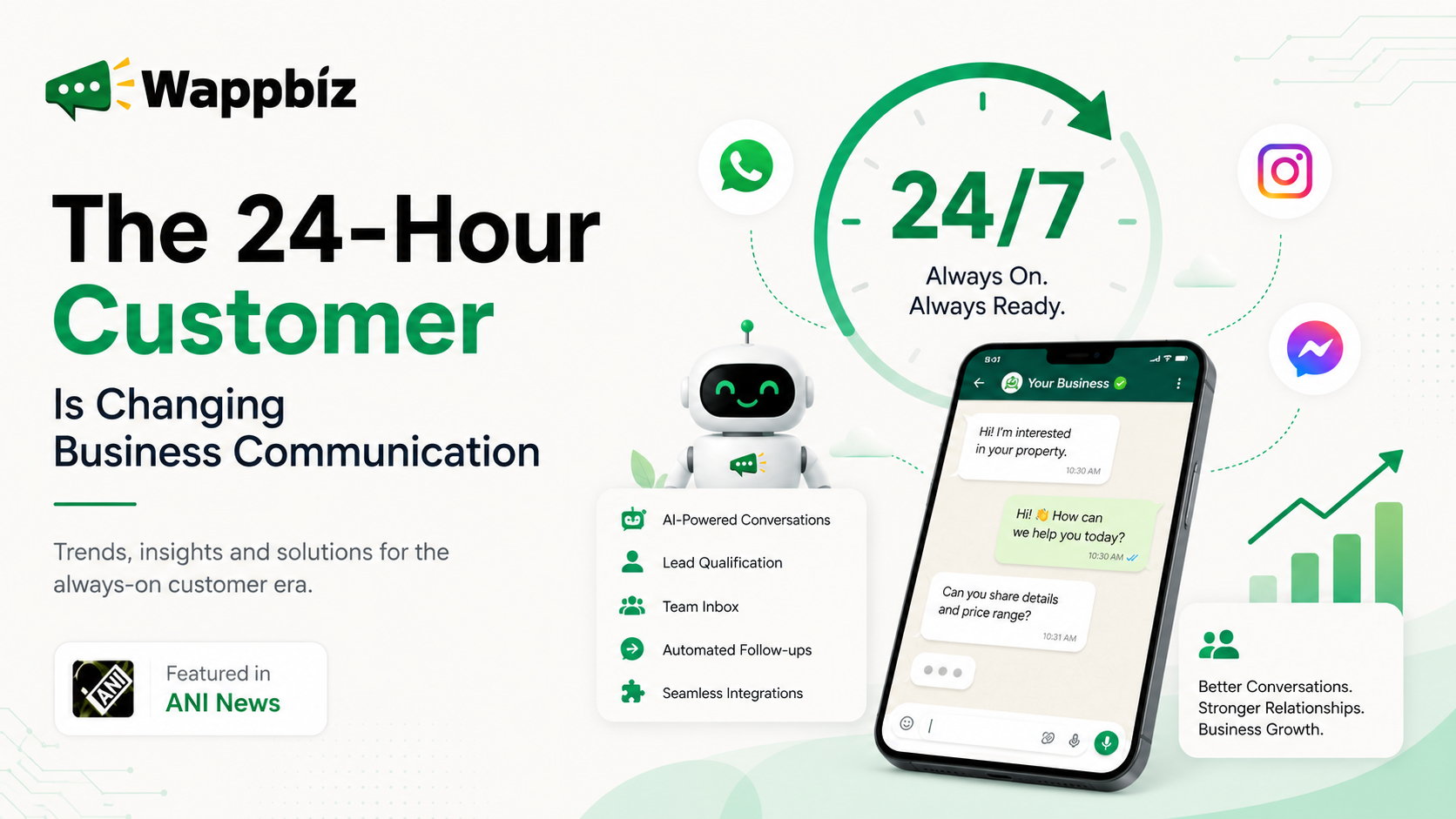
This shift is creating what can increasingly be described as the 24-hour customer—and it is changing what businesses need from their customer communication infrastructure. Recent coverage by ANI News has highlighted this changing behaviour and the challenges businesses face when customer conversations continue to depend on personal phones, unmanaged WhatsApp accounts, disconnected teams, and manual follow-ups.
For businesses, the challenge is no longer simply being available on WhatsApp. It is building the infrastructure required to capture, understand, manage, automate, and continue customer conversations at scale.
Customer Expectations Are Moving Beyond Business Hours
The way customers communicate with businesses has changed considerably. Messaging has made starting a conversation almost effortless, and that convenience has influenced what customers expect after sending the first message. According to figures cited in the ANI News coverage from WhatsApp’s 2026 State of Business Messaging report, based on a Meta-commissioned Kantar study across 22 global markets including India, 69% of consumers consider waiting on hold a waste of time, while nearly 80% say they need proof of legitimacy before engaging with a brand’s message.
These expectations present businesses with two simultaneous challenges: customers want faster communication, but they also want communication they can trust.
For industries such as real estate, healthcare, travel, retail, and D2C, this can become particularly important because customer intent can develop quickly. A delayed response to a property enquiry, product question, appointment request, or purchase-related conversation may mean the customer continues their journey elsewhere. Being available is therefore becoming less about extending working hours and more about creating systems capable of supporting customers when conversations happen.
The Real Problem Isn’t More Messages, It’s Disconnected Conversations
As messaging volumes increase, the problem is not simply the number of messages a business receives. The bigger challenge is what happens behind those conversations. When customer interactions are managed through personal phones or disconnected WhatsApp accounts, conversations can become difficult for teams to track. One employee may have context that another does not. A promising enquiry may receive an initial response but no follow-up. A customer may need to repeat information when the conversation moves between team members.
The problem becomes even more complex when customers interact with businesses across different channels.
A prospect may discover a business through Instagram, start a conversation through a DM, respond to a Facebook campaign, and later continue the interaction through WhatsApp. From the customer’s perspective, these interactions are all with the same business. Businesses therefore need to think beyond individual messages and start thinking about the continuity of the customer conversation.
Why Businesses Need Customer Conversation Infrastructure
Meeting the expectations of the 24-hour customer does not necessarily mean placing more people behind phones around the clock. The more scalable approach is building communication infrastructure that combines automation with human involvement.
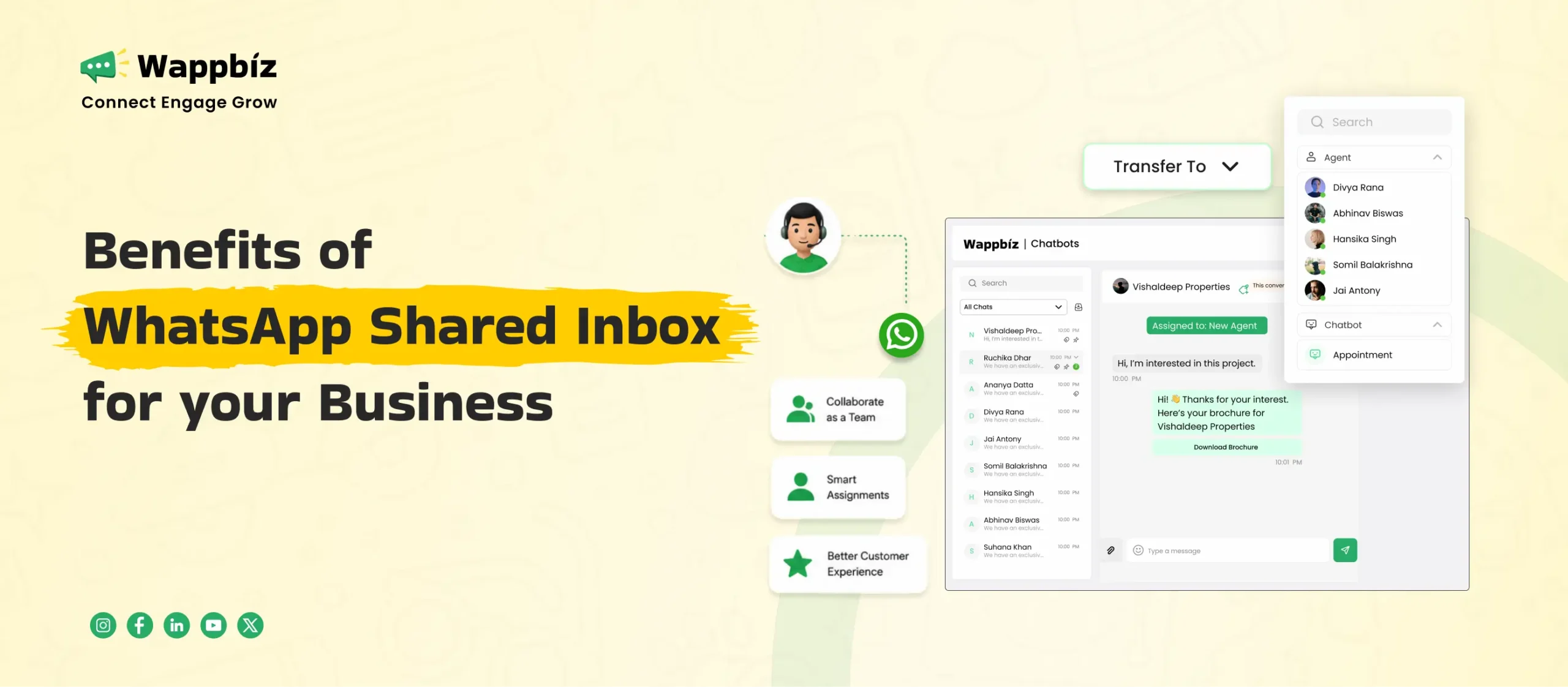
WhatsApp business platforms are increasingly bringing together capabilities such as shared team inboxes, AI-powered customer conversations, automated follow-ups, lead management, and integrations with existing business systems. This creates a different model for customer engagement.
Automation can handle repetitive initial interactions and collect information. AI can help respond to common or open-ended questions. Customer requirements can be captured before a conversation reaches a salesperson. Conversations can then be assigned to the appropriate team, while follow-up workflows help maintain engagement after the initial interaction.
Human teams remain essential, particularly when customers need consultation, negotiation, problem-solving, or more complex assistance. The role of technology is to ensure those teams enter conversations with greater context and spend their time where human involvement adds the most value.
AI Is Changing the First Customer Interaction
One of the most significant developments in business messaging is the growing use of AI-powered conversational agents. Traditional chatbot experiences often depend heavily on predefined questions, buttons, and decision trees. These remain useful for structured workflows, but AI introduces the ability to understand more open-ended customer questions and respond using relevant business information.
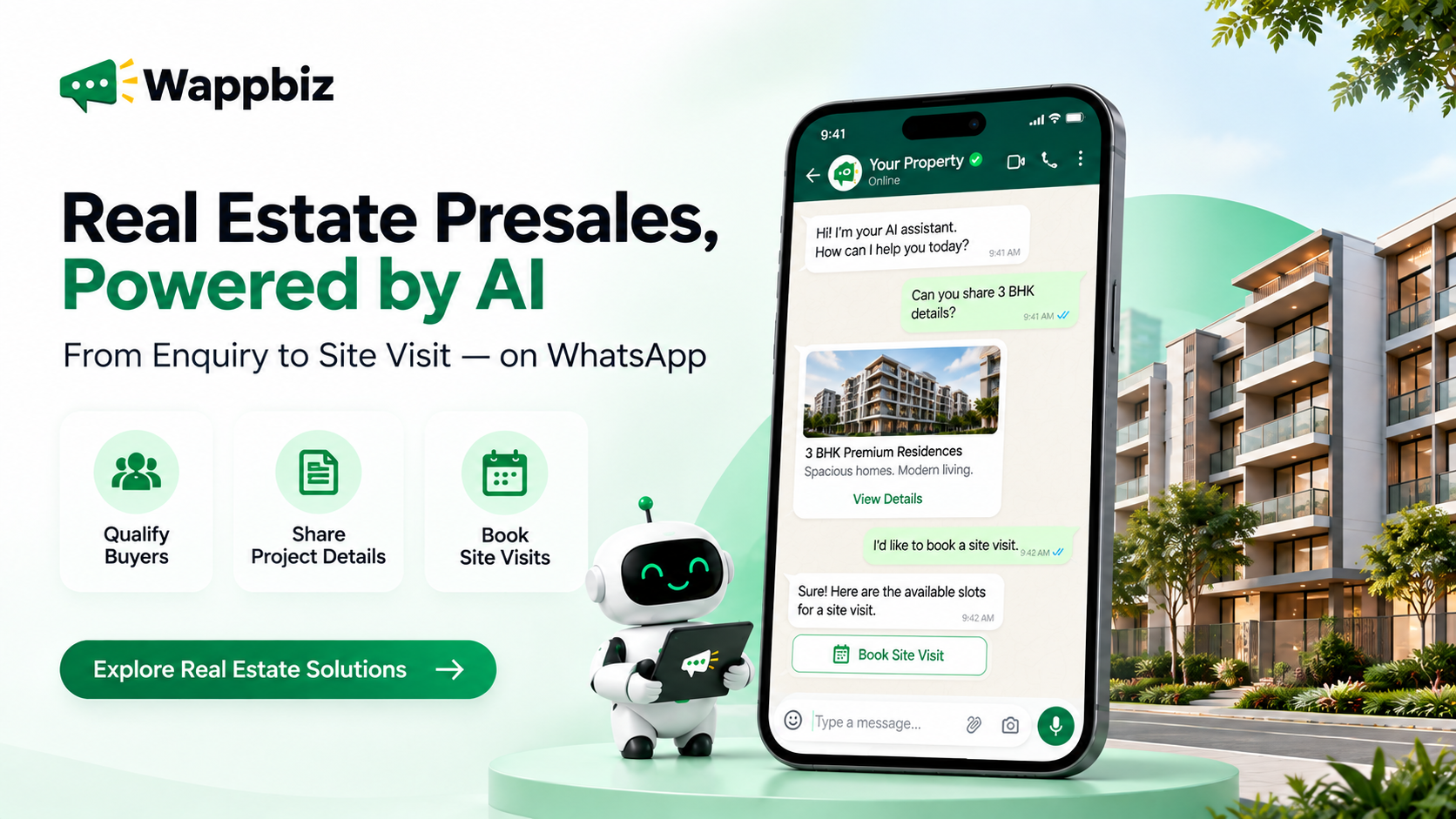
The ANI coverage highlights this evolution toward specialized AI sales and support agents operating with business-specific knowledge. Consider a real estate enquiry. A prospective buyer may want to know about available properties, configurations, pricing, amenities, floor plans, brochures, or site visits. Instead of requiring a salesperson to manually handle every initial question, an AI-supported conversation can help address common enquiries, understand requirements, collect relevant information, and move the prospect toward an appropriate next step.
The objective is not simply to generate faster replies. It is to make the first customer interaction more useful.
From Customer Enquiry to a Connected Business Workflow
Customer messaging becomes significantly more valuable when conversations are connected with the systems businesses already use. A WhatsApp conversation may begin with a simple question, but the information generated during that interaction can become relevant to lead management, CRM processes, sales ownership, customer support, ecommerce, appointments, or follow-ups.
The ANI coverage discusses this need for integration and references WappBiz’s ability to connect messaging with existing business workflows, including integration with MDOC in the real estate sector and support for other business applications. This connectivity helps move businesses away from isolated conversations.
For example, a property enquiry should ideally not end after a chatbot answers a question. The customer’s requirements can become part of a larger journey in which intent is understood, the opportunity is qualified, the appropriate salesperson becomes involved, a site visit is arranged, and subsequent communication continues with the necessary context.
Messaging then becomes part of the operational customer journey rather than a separate communication layer.
What Always-On Customer Engagement Looks Like in Practice
Always-on engagement does not mean bombarding customers with automated messages or attempting to remove people from every interaction. It means designing a customer journey where the next appropriate action does not depend entirely on someone manually noticing a message.
A customer can initiate an enquiry and receive immediate assistance. Automation can understand the initial requirement and capture relevant information. A chatbot or AI agent can handle appropriate questions. A qualified conversation can move to the right team member, and follow-up can continue when the customer is not immediately ready to make a decision.
The journey becomes: Customer Enquiry → Automated Assistance → Requirement Capture → Qualification → Team Assignment → Human Conversation → Follow-Up → Conversion
The technology supports continuity while allowing human teams to focus on conversations that require judgement, expertise, and relationship-building.
The Opportunity Goes Beyond WhatsApp
WhatsApp is an important part of business messaging, but customer conversations increasingly span the wider Meta ecosystem. A customer might discover a brand through Instagram, initiate a conversation through Instagram DMs, engage with an advertisement on Facebook, or contact the business through WhatsApp.
Managing each of these as an isolated channel creates many of the same fragmentation problems businesses are trying to solve. WappBiz is building around a broader approach to customer engagement across WhatsApp, Instagram DMs, and Facebook Messenger, helping businesses manage and automate conversations across multiple Meta channels.
This becomes increasingly important as businesses invest more heavily in social media and Meta advertising. The objective should not be merely generating another click or message. Businesses need infrastructure capable of taking the conversation forward once customer interest has been created.
Building for the 24-Hour Customer
The emergence of the 24-hour customer does not mean every business needs a human team online every minute of every day. It means businesses need to reconsider what happens when a customer reaches out and nobody is immediately available.
Can the customer receive useful assistance? Can their requirement be understood? Can important information be captured? Can the conversation reach the appropriate person? Can the business follow up without relying entirely on individual memory? These are increasingly infrastructure questions rather than simply staffing questions.
Businesses that combine AI, automation, team collaboration, customer context, follow-up workflows, and connected business systems can create customer experiences that remain responsive even as conversation volumes increase.
The result is not automation for the sake of automation. It is a more structured approach to ensuring that valuable customer conversations can continue moving forward. For the 24-hour customer, that continuity is quickly becoming an expectation rather than an added convenience.
WappBiz and the Future of Business Messaging
This changing customer communication landscape was recently highlighted in ANI News in its coverage, “The 24-Hour Customer Is Here And Most Businesses Aren’t Ready For Them.”
The article discusses the growing gap between customer expectations and traditional communication models and highlights WappBiz among the platforms helping businesses build more structured messaging infrastructure through shared team conversations, AI-powered engagement, automation, follow-ups, and integrations.
For WappBiz, the direction is clear: customer messaging should not exist as a collection of disconnected chats.
Read the original coverage: The 24-Hour Customer Is Here And Most Businesses Aren’t Ready For Them — ANI News