
A well-defined WhatsApp marketing guide helps businesses use WhatsApp for structured customer communication, lead nurturing, sales follow-ups, and support automation. WhatsApp is already where many Indian customers prefer to interact with brands, but using it manually often leads to missed leads, delayed replies, and inconsistent follow-ups. For many brands, the real challenge is not starting WhatsApp marketing. It is doing it properly.
Sending random bulk messages from personal numbers is not a strategy. A strong WhatsApp marketing system uses opt-in contacts, approved templates, segmentation, automation, analytics, and a platform like WappBiz to manage everything from one place.
What Is WhatsApp Marketing?
WhatsApp marketing is the use of WhatsApp to communicate with customers throughout their journey from lead generation and promotions to sales follow-ups, customer support, reminders, and post-purchase engagement. Instead of relying only on emails or phone calls, businesses use WhatsApp to create faster, more direct, and more personal conversations with customers.
Because WhatsApp is already a part of people’s daily communication habits, businesses can engage customers in a space they actively check and respond to. This makes WhatsApp one of the most effective channels for real-time customer interaction. It includes.
- Product offers and festive campaigns
- Abandoned cart reminders
- Lead follow-ups
- Appointment confirmations
- Order and delivery updates
- Event invitations
- Customer support automation
- Feedback and review requests
For small businesses, WhatsApp marketing may start with the WhatsApp Business App. But as message volume, team size, and automation needs grow, businesses usually move to the WhatsApp Business API.
The WhatsApp Business API is designed for structured communication at scale. It supports multi-agent access, chatbot automation, CRM integration, large-scale messaging workflows, and analytics through platforms like WappBiz.
Why Use WhatsApp Marketing?
WhatsApp marketing works because it fits naturally into how customers already communicate. Unlike email, where messages can remain unread for days, WhatsApp feels immediate and personal. Customers do not need to download a new app, remember a login, or search through long inboxes. They can simply reply, click a button, confirm an appointment, ask a question, or complete the next step inside the chat.
Businesses use WhatsApp marketing because it helps them:
- Respond faster to customer enquiries
- Reduce dependency on manual follow-ups
- Improve lead nurturing
- Send timely reminders
- Re-engage old databases
- Automate support queries
- Track campaign performance
- Improve sales team visibility
For Indian businesses, WhatsApp is especially powerful because many customers are already comfortable using it for business conversations, service updates, and purchase decisions.
WhatsApp Marketing Use Cases
1. Lead Generation
Businesses can capture leads directly through Click-to-WhatsApp ads, website chat buttons, QR codes, landing pages, and enquiry forms. Instead of making customers fill long forms or wait for callbacks, businesses can start conversations instantly on WhatsApp and collect information in a more natural and interactive way.
Because the interaction happens inside WhatsApp itself, customers are more likely to respond quickly and continue the conversation. Businesses can engage leads while their interest is still high, reducing drop-offs that usually happen with traditional forms or delayed follow-ups. It also creates a smoother experience where enquiries feel more like conversations rather than formal lead submission processes.
For example, an education institute can run Instagram ads that open directly on WhatsApp. An automated chatbot can ask the student about their preferred course, qualification, budget, and admission timeline before routing the enquiry to the counselling team.
Similarly, a healthcare clinic can use QR codes in offline campaigns to guide patients to WhatsApp, where they can select services, book appointments, and receive automated confirmations without manual coordination.
2. Lead Qualification
When businesses start receiving a large number of enquiries, manually calling every lead becomes difficult, time-consuming, and inconsistent. Sales teams often spend hours asking the same basic questions repeatedly, while many leads may not even be ready to buy. This slows down response times and makes it harder to identify serious prospects quickly.
With WhatsApp automation, businesses can qualify leads automatically the moment a customer starts a conversation. Instead of waiting for a sales representative to collect information manually, a chatbot can instantly engage the customer and guide them through a simple conversation flow.
The chatbot can collect details such as:
- Customer name
- City or preferred location
- Budget range
- Product or service requirement
- Purchase timeline
- Product interest
- Preferred callback time
Because the interaction happens conversationally on WhatsApp, customers usually respond more comfortably and naturally compared to filling long enquiry forms or waiting for follow-up calls.
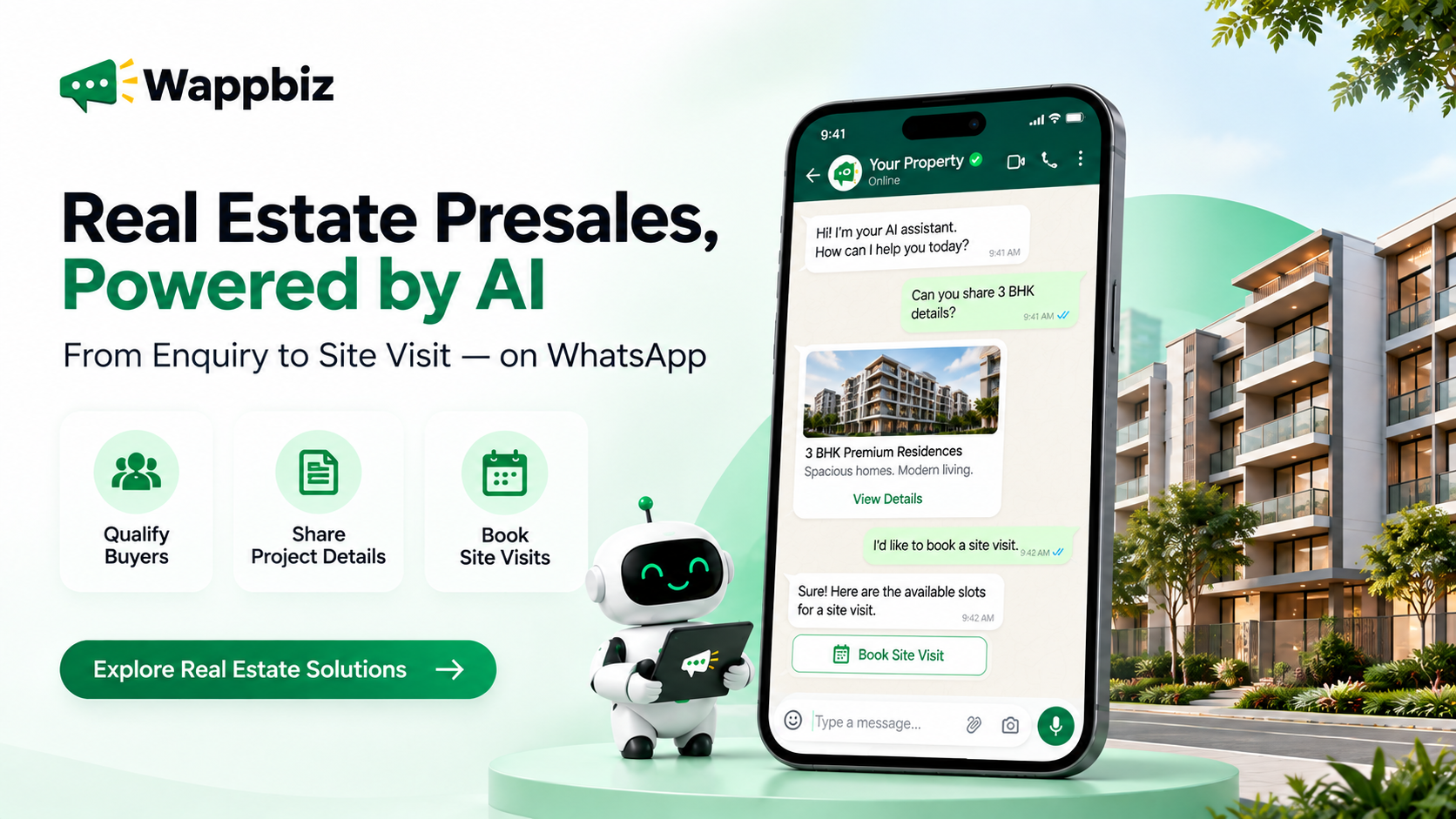
For example, a real estate developer running Click-to-WhatsApp ads can automatically ask buyers whether they are looking for residential or commercial property, their preferred location, expected budget, and whether they are planning to purchase immediately or later.
3. Drip Campaigns
WhatsApp drip campaigns help businesses stay connected with customers through a planned sequence of automated messages sent over time. Instead of relying on one-time follow-ups or manual reminders, businesses can nurture leads gradually with relevant information based on the customer journey.
This creates more consistent engagement and helps businesses remain top-of-mind without overwhelming customers with repetitive communication. Drip campaigns are especially useful when customers take time to make decisions and require multiple touchpoints before converting.
For example:
- Day 1: Welcome message
- Day 3: Product or service details
- Day 5: Customer testimonial or success story
- Day 7: Offer reminder or consultation invitation
- Day 10: Final follow-up or re-engagement message
Because the communication is automated and scheduled in advance, businesses can maintain regular follow-ups at scale without manually tracking every lead.
For example, a real estate company can automatically send project brochures, site visit reminders, construction updates, and pricing information over several days after a buyer enquiry.
4. Abandoned Cart Recovery
Ecommerce businesses often lose potential sales when customers add products to their cart but leave the website before completing the purchase. In many cases, customers are interested but get distracted, compare options elsewhere, or postpone the decision temporarily.
WhatsApp automation helps businesses re-engage these customers quickly while the purchase intent is still high. Instead of losing the lead completely, businesses can send personalized reminders that encourage customers to return and complete the order.
For example, an ecommerce brand can automatically send a WhatsApp message containing the product image, item details, coupon code, payment link, or limited-time offer shortly after the cart is abandoned. The message feels more direct and visible compared to traditional email reminders, which are often ignored or unopened.
Businesses can also create follow-up sequences such as:
- First reminder after 30 minutes
- Discount offer after 24 hours
- Limited stock alert after 2 days
- Final reminder before the offer expires
This approach helps recover lost sales, improve conversion rates, and maintain engagement without requiring manual follow-ups from the sales or support team.
Because customers already use WhatsApp daily, the communication feels faster, more conversational, and easier to respond to, making abandoned cart recovery significantly more effective for ecommerce brands.
5. Appointment Reminders
Healthcare clinics, salons, consultants, and education counselors often deal with missed appointments, delayed confirmations, and last-minute cancellations. In many cases, customers forget their booking, overlook reminder calls, or fail to respond on time, leading to lost revenue and scheduling inefficiencies.
WhatsApp automation helps businesses reduce no-shows by creating a structured appointment reminder system that keeps customers informed and engaged throughout the booking journey. Because reminders are delivered on WhatsApp — a platform customers actively check throughout the day — the chances of responses and confirmations are significantly higher compared to emails or manual calls.
A typical appointment automation flow can include:
- Booking confirmation
- 24-hour reminder
- 2-hour reminder
- Confirm or reschedule button
- Follow-up message after the appointment
For example, a healthcare clinic can automatically send appointment confirmations, doctor details, clinic location, and reminder notifications before the consultation. Patients can confirm or reschedule directly through WhatsApp without calling the clinic manually.
Similarly, salons and consultants can reduce missed appointments by sending timely reminders along with quick response buttons that make rescheduling easier for customers.
This structured communication not only improves appointment attendance but also reduces manual coordination work for front desk teams, improves customer experience, and helps businesses manage schedules more efficiently.
6. Order and Delivery Updates
Ecommerce and logistics businesses handle large volumes of customer communication after an order is placed. Customers usually want regular updates about payment status, shipping progress, delivery timelines, and order confirmation. When updates are delayed or unclear, support teams often receive repeated calls and enquiries asking for order status.
WhatsApp automation helps businesses keep customers informed throughout the entire order journey with real-time notifications and delivery updates. Because messages are delivered instantly on WhatsApp, customers can easily track their orders without needing to contact support teams manually.
A typical order communication flow can include:
- Order confirmation
- Payment confirmation
- Shipping update
- Out-for-delivery alert
- Delivery confirmation
- Feedback or review request
For example, an ecommerce brand can automatically send customers their order details, payment receipt, tracking information, and delivery notifications directly on WhatsApp after a purchase is completed.
Similarly, logistics and delivery companies can send live shipment updates, estimated delivery timings, and proof-of-delivery confirmations to improve transparency and customer confidence.
These automated updates help businesses build customer trust, reduce uncertainty, and significantly lower repetitive support queries related to order tracking and delivery status. It also improves the post-purchase experience by keeping customers informed at every stage without requiring manual follow-ups.
7. Customer Support
WhatsApp chatbots help businesses manage customer conversations more efficiently by handling common queries instantly without requiring manual responses for every interaction. Instead of making customers wait for support teams to reply, businesses can provide immediate assistance 24/7 through automated conversations on WhatsApp.
These chatbots can handle a wide range of customer interactions such as:
- Frequently asked questions (FAQs)
- Product or pricing enquiries
- Refund or payment status updates
- Booking or appointment issues
- Service requests
- Order tracking support
- Complaint registration
- Escalation routing
For example, an ecommerce business can use a chatbot to answer questions about product availability, delivery timelines, return policies, and refund status automatically. Similarly, a travel company can help customers check booking details, reschedule tickets, or request support directly through WhatsApp.
The biggest advantage is that customers receive instant responses even outside business hours, improving overall customer experience and reducing support workload for teams.
If the chatbot cannot resolve a query or detects that the customer needs personalized assistance, the conversation can automatically be transferred to a human agent through a shared team inbox. This allows support teams to step in only when required while still maintaining smooth and uninterrupted communication.
This combination of automation and human support helps businesses improve response times, reduce repetitive manual work, and manage large volumes of customer conversations more efficiently.
Best Practices for WhatsApp Marketing
Get Clear Customer Opt-In
Businesses should communicate with customers on WhatsApp only after receiving proper consent or opt-in. Customers should clearly understand what type of messages they are agreeing to receive, whether it is promotional offers, appointment reminders, order updates, or support communication.
WhatsApp also requires businesses to follow Meta’s messaging policies, especially when sending business-initiated messages outside the 24-hour customer service window. In such cases, approved message templates must be used.
For businesses operating in India, promotional communication should also be managed carefully with proper consent collection and opt-out mechanisms, particularly in the context of evolving data protection and telecom regulations.
Obtaining clear permission not only helps maintain compliance but also improves customer trust and engagement quality.
Segment Your Audience Properly
One of the biggest mistakes businesses make is sending the same message to every customer. Different customers have different interests, buying intent, budgets, and engagement levels. Relevant communication performs significantly better than generic broadcasts.
Businesses should segment customers based on factors such as:
- Location
- Interest or enquiry type
- Purchase history
- Lead stage
- Budget range
- Engagement level
- Industry
- Last interaction or activity
For example, a real estate buyer searching for a ₹60 lakh residential apartment should not receive the same communication as an investor looking for commercial office space.
Proper segmentation helps businesses send more targeted, useful, and conversion-focused communication.
Personalise Every Message
Personalized communication feels more natural and relevant compared to generic mass messaging. Even simple personalization can improve customer engagement and response rates significantly.
Businesses can use dynamic variables such as:
- {{name}}
- {{city}}
- {{product}}
- {{appointment_date}}
- {{order_id}}
For example: “Hi {{name}}, your appointment for {{service}} is confirmed for {{appointment_date}}.”
This creates a more conversational customer experience and makes the communication feel directly relevant to the recipient.
Keep Messages Short and Clear
WhatsApp is designed for quick and conversational communication. Long paragraphs often reduce readability and response rates. Messages should be:
- Short
- Clear
- Easy to understand
- Action-oriented
Instead of overwhelming customers with too much information, businesses should focus on communicating one clear message at a time.
Example: “Hi {{name}}, your site visit for {{project}} is confirmed for tomorrow at 11 AM. Reply 1 to confirm or 2 to reschedule.”
Simple and direct messages usually perform better on WhatsApp.
Use Approved Templates Correctly
For businesses using the WhatsApp Business API, any business-initiated message sent outside the 24-hour customer service window must use an approved WhatsApp template. Meta reviews these templates to maintain message quality, reduce spam, and protect user experience on the platform.
Templates are commonly used for:
- Promotional campaigns
- Appointment reminders
- Order updates
- Payment reminders
- Authentication messages
Businesses should ensure templates are relevant, compliant, and clearly categorized according to WhatsApp policies.
Always Include a Clear CTA
Every WhatsApp campaign should guide the customer toward one specific action. Without a clear CTA (Call-to-Action), customers may read the message but not know what to do next. Examples of strong WhatsApp CTAs include:
- Reply YES
- Book now
- View catalogue
- Talk to an expert
- Confirm appointment
- Claim offer
- Download brochure
A single clear action improves engagement and makes conversations easier to continue.
Respect Customer Opt-Outs
Customers should always have an easy option to stop receiving marketing communication if they choose to. For example:
“Reply STOP to opt out.”
Respecting opt-outs is important for:
- Maintaining customer trust
- Protecting brand reputation
- Reducing spam complaints
- Maintaining a healthy WhatsApp quality rating
Businesses that ignore opt-outs or send excessive irrelevant messages risk lower engagement and possible messaging restrictions from WhatsApp.
Difference Between WhatsApp Business API and WhatsApp Business App
| Feature | WhatsApp Business App | WhatsApp Business API |
| Best for | Small businesses | Growing businesses and enterprises |
| Users | Limited/manual usage | Multi-agent teams |
| Automation | Basic greeting and away messages | Chatbots, workflows, triggers |
| Broadcasts | Limited | Scalable with approved templates |
| CRM integration | Not available | Available |
| Analytics | Basic or limited | Campaign and performance tracking |
| Team inbox | No structured inbox | Shared inbox with assignment |
| Use case | Manual conversations | Sales, support, marketing automation |
The WhatsApp Business App is suitable when one person is handling a small number of chats. The WhatsApp Business API is better when the business needs automation, team collaboration, campaign management, CRM integration, and large-scale communication.
Because the API does not come with its own front-end dashboard, businesses use platforms like WappBiz to manage campaigns, chatbots, templates, contacts, team inboxes, and analytics.
How to Get Started with WhatsApp Marketing
Starting WhatsApp marketing should be systematic. Here is a practical step-by-step process.
Step 1: Define Your Goal
Decide what you want WhatsApp marketing to achieve.
Your goal could be:
- Generate more leads
- Increase appointment attendance
- Recover abandoned carts
- Improve customer support
- Promote offers
- Nurture old leads
- Increase repeat purchases
A clear goal helps you create the right campaign flow.
Step 2: Choose App or API
Use the WhatsApp Business App if your message volume is low and one person can manage conversations manually.
Use the WhatsApp Business API if you need:
- Bulk campaigns
- Chatbots
- Team inbox
- CRM integration
- Drip campaigns
- Analytics
- Automated follow-ups
- Scalable customer communication
Step 3: Build an Opt-In Contact List
Collect consent through:
- Website forms
- WhatsApp buttons
- QR codes
- Checkout pages
- Lead forms
- Events
- Landing pages
- Click-to-WhatsApp ads
Do not buy databases. They usually damage trust, lower engagement, and increase the risk of blocks or reports.
Step 4: Create Approved Templates
Prepare templates for different use cases:
- Marketing offers
- Appointment reminders
- Order updates
- Payment reminders
- Event invitations
- Lead follow-ups
- Feedback requests
Templates should be clear, honest, and aligned with the right category.
Step 5: Set Up Automation
Use automation for repetitive communication.
Examples:
- Instant reply to new enquiries
- Lead qualification chatbot
- Follow-up sequence
- Reminder workflow
- Support routing
- Re-engagement campaign
WappBiz helps businesses connect WhatsApp messaging with structured workflows, including triggers, segmentation, team visibility, and integrations.
Step 6: Launch, Measure, and Improve
Once the campaign is live, track results regularly. Improve message copy, timing, audience segments, and CTAs based on performance.
WhatsApp Marketing Strategies That Work
A successful WhatsApp marketing strategy is not about sending more messages or running constant broadcasts. The real goal is to create timely, relevant, and personalized communication that matches customer intent at different stages of their journey.
Businesses that treat WhatsApp as a structured communication channel — rather than just a messaging app — usually see better engagement, faster response times, stronger customer relationships, and higher conversion rates.
Below are some of the most effective WhatsApp marketing strategies businesses use across industries.
1. Use Click-to-WhatsApp Ads
Click-to-WhatsApp ads allow customers to start a WhatsApp conversation directly from Facebook or Instagram ads with a single tap.
Instead of filling long lead forms or waiting for callbacks, customers can instantly ask questions and interact with the business while their interest is still high. This reduces friction and improves lead quality because conversations start immediately.
Businesses can also automate the first interaction using chatbots to qualify enquiries before assigning them to sales teams.
Click-to-WhatsApp ads work especially well for:
- Real estate enquiries
- Education counselling
- Healthcare appointments
- Travel packages
- Product enquiries
- High-ticket services
For example, a real estate developer can run Instagram ads that open directly on WhatsApp, where buyers can instantly ask about pricing, location, availability, and site visit scheduling.
2. Create Lifecycle-Based Campaigns
One of the most effective WhatsApp marketing approaches is mapping communication around the customer lifecycle instead of sending random promotions.
Different customers require different communication depending on where they are in the buying journey.
For example, in ecommerce:
- New visitor
- Product interest shown
- Cart abandoned
- Purchase completed
- Delivery completed
- Review request
- Repeat purchase reminder
Similarly, in real estate:
- New enquiry
- Budget qualification
- Brochure shared
- Site visit scheduled
- Site visit reminder
- Post-visit follow-up
- Inventory update
Lifecycle-based communication performs better because it aligns messaging with customer intent and decision-making stages instead of sending irrelevant broadcasts.
3. Use Chatbots for Instant Responses
Response speed plays a major role in lead conversion and customer experience.
If a customer messages your business late at night and receives a response the next morning, there is a high chance they may already be talking to another business.
WhatsApp chatbots help businesses respond instantly by:
- Greeting customers automatically
- Collecting lead details
- Answering FAQs
- Sharing brochures or catalogues
- Booking appointments
- Routing conversations to the right team
This ensures businesses never miss enquiries due to delayed responses while also reducing manual workload for sales and support teams.
4. Build Segmented Broadcast Campaigns
Generic bulk messaging often leads to poor engagement and higher opt-out rates.
Instead of sending the same campaign to every customer, businesses should segment audiences and send communication based on relevance and customer behavior.
For example, businesses can create separate campaigns for:
- New customers
- Repeat buyers
- Inactive leads
- High-intent prospects
- City-wise audiences
- Product-specific interests
- Festival shoppers
A customer interested in premium products should not receive the same communication as a first-time low-budget buyer.
Segmentation improves personalization, campaign relevance, engagement quality, and conversion rates.
5. Use Drip Campaigns for Long Decision Cycles
Not every customer makes a decision immediately.
Industries such as real estate, education, healthcare, finance, and B2B services often involve longer decision-making cycles where customers require multiple touchpoints before converting.
WhatsApp drip campaigns help businesses nurture leads automatically through scheduled follow-up messages over time.
For example:
- Day 1: Welcome message
- Day 3: Product details
- Day 5: Customer testimonial
- Day 7: Offer reminder
- Day 10: Final follow-up
This helps businesses stay visible and maintain engagement without manually following up with every prospect.
6. Integrate WhatsApp with CRM Systems
Connecting WhatsApp with CRM systems helps businesses organize communication more effectively and maintain visibility across the customer journey.
With CRM integration, businesses can track:
- Lead source
- Customer stage
- Conversation history
- Follow-up status
- Sales ownership
- Customer preferences
This reduces missed follow-ups, improves accountability, and ensures sales teams always have access to updated customer information.
For example, when a customer responds to a WhatsApp campaign, the CRM can automatically update lead status and assign the enquiry to the appropriate team member.
7. Use WhatsApp for Customer Retention
Many businesses focus only on pre-sales communication and ignore customers after purchase. However, retention communication often delivers long-term business growth at a lower cost compared to acquiring new customers repeatedly.
WhatsApp can be used for post-purchase engagement such as:
- Customer onboarding
- Product usage tips
- Renewal reminders
- Feedback collection
- Support assistance
- Loyalty offers
- Repeat purchase campaigns
For example, a healthcare clinic can send follow-up care reminders, while an ecommerce brand can recommend refill or repeat purchase options based on previous orders.
Consistent post-purchase engagement helps businesses build trust, improve retention, and increase customer lifetime value.
Metrics to Track WhatsApp Marketing Performance
Running campaigns without tracking performance makes it difficult to understand what is actually working. Businesses should regularly monitor key metrics to evaluate engagement quality, customer behavior, and business outcomes.
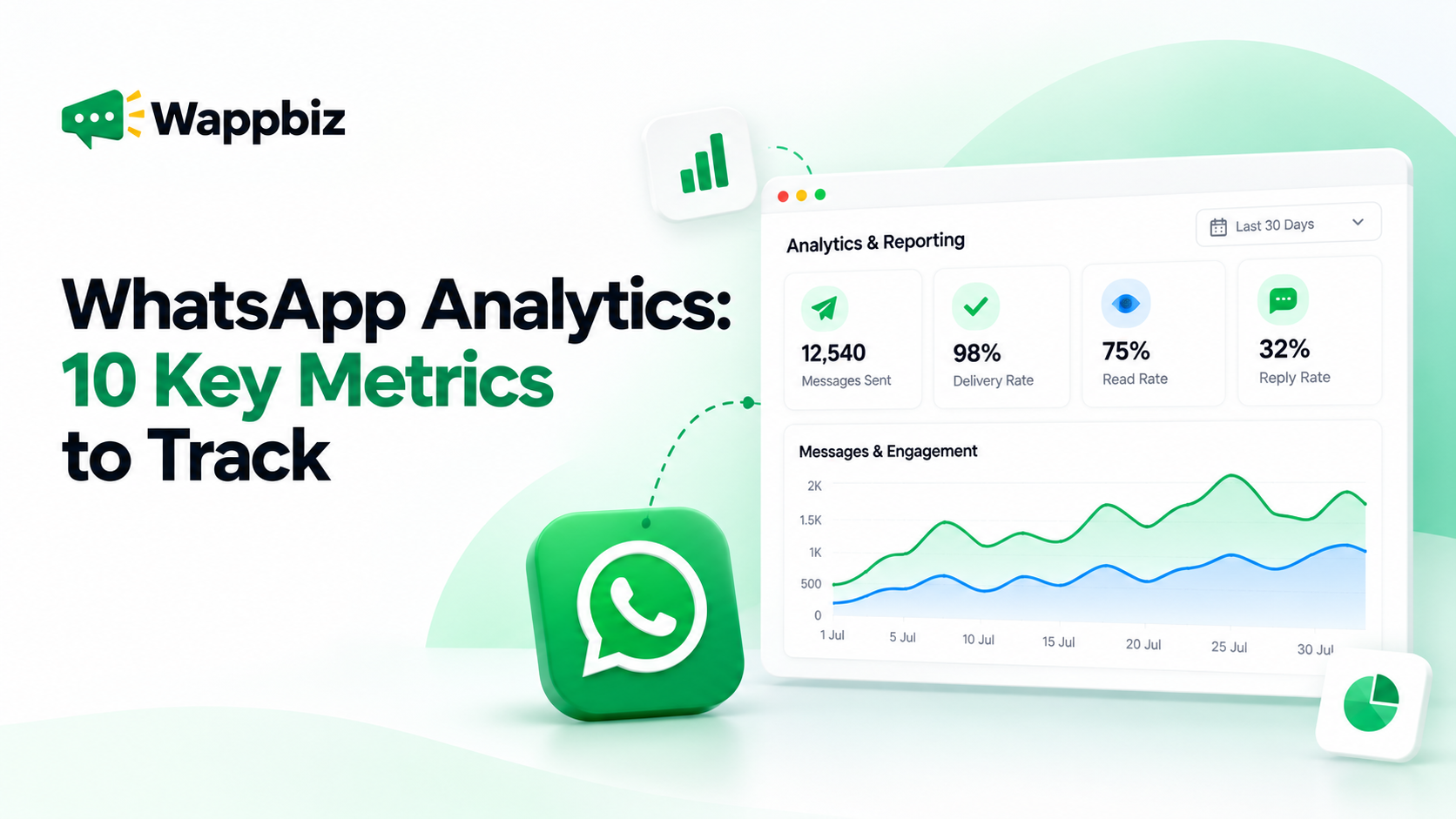
Delivery Rate
Delivery rate shows how many messages were successfully delivered to customers.
Low delivery rates may indicate:
- Incorrect phone numbers
- Inactive contacts
- Poor contact quality
- Messaging restrictions
Maintaining healthy delivery rates is important for campaign effectiveness.
Read Rate
Read rate measures how many customers opened and viewed the message.
WhatsApp typically performs well in terms of visibility because users actively check messages throughout the day. However, high read rates alone do not guarantee conversions. Businesses should combine read rates with engagement and conversion metrics for better analysis.
Reply Rate
Reply rate measures how many users responded to the message. This is one of the strongest indicators of campaign relevance and customer interest.
Higher reply rates usually indicate:
- Better targeting
- More relevant messaging
- Stronger customer intent
Click-Through Rate (CTR)
If campaigns include links, businesses should track how many users clicked on them. This helps measure interest in:
- Product catalogues
- Brochures
- Landing pages
- Booking forms
- Payment links
- Demo pages
CTR helps businesses understand whether customers are taking action beyond simply reading messages.
Conversion Rate
Conversion rate is one of the most important business metrics for WhatsApp marketing. It measures how many conversations actually turned into business outcomes such as:
- Purchases
- Site visits
- Bookings
- Consultations
- Demo requests
- Form submissions
- Renewals
This helps businesses evaluate the actual revenue impact of WhatsApp campaigns.
Opt-Out Rate
Opt-out rate shows how many users stopped receiving communication.
A rising opt-out rate may indicate:
- Excessive messaging frequency
- Poor targeting
- Irrelevant campaigns
- Low-value communication
Monitoring opt-outs helps businesses improve communication quality and customer experience.
Response Time
For sales and support teams, response time directly affects customer satisfaction and lead conversion. Businesses using automation and shared team inboxes can reduce delays significantly and provide faster customer assistance.
Faster response times usually improve engagement and conversion opportunities.
Agent Performance
Businesses with multiple sales or support agents should also track operational performance metrics such as:
- Number of chats handled
- Average response time
- Resolution time
- Lead conversion rate
- Escalation handling
- Missed conversations
This helps businesses improve team efficiency, accountability, and customer handling quality.
Why Invest in WhatsApp Marketing?
Businesses should invest in WhatsApp marketing because customer communication is no longer limited to ads, calls, and emails. Customers want fast answers. They want reminders. They want updates. They want the ability to reply easily. WhatsApp marketing helps businesses turn scattered conversations into a structured growth channel. It is especially useful when:
- Leads are coming from ads but not converting
- Sales teams are missing follow-ups
- Customers are not reading emails
- Support teams are overloaded
- Old databases are inactive
- Teams are using multiple personal numbers
- Businesses need automation without losing personalisation
The investment is not just in messaging. It is in better lead handling, faster response, cleaner workflows, and measurable communication.
Conclusion
This whatsapp marketing guide shows that WhatsApp marketing is most effective when it is built as a structured communication system, not as random bulk messaging. Businesses need consent-based contact lists, approved templates, audience segmentation, automation, clear CTAs, and performance tracking.
The key takeaway is simple: WhatsApp can support marketing, sales, support, and retention when it is connected to real business workflows.
WappBiz helps businesses use the official WhatsApp Business API to automate conversations, run campaigns, manage team inboxes, build chatbots, track analytics, and scale customer communication with confidence. Ready to turn WhatsApp into a growth channel? Start your free trial with WappBiz or book a demo today.