
Most jewellery stores don’t have a demand problem.
They have a visibility and timing problem.
Campaigns are running. Festive creatives go out. Gold rate updates are broadcast. Collections are launched. The effort is real.
But sales spikes feel unpredictable. ROI feels inconsistent.
Take a simple example — a store with 5,000 contacts sends four bulk messages a month. That’s 20,000 paid conversations. If only 20-30% of those customers are actually relevant for each message, 70% of the cost is wasted.
Engagement drops. Costs rise.
And slowly the conclusion becomes:
“Maybe WhatsApp Business API isn’t working for us.”
But the problem isn’t the API.
It’s using it without timing and segmentation strategy.
This is a pattern we often see when working with jewellery brands adopting WhatsApp-led communication. You can explore how structured messaging systems work specifically for this industry on our Jewellery industry solutions page.
When Communication Follows Routine Instead of Intent
Most jewellery communication follows a routine.
Campaigns are lined up. Messages are scheduled. Broadcasts go out because they were planned in advance.
But jewellery buying doesn’t happen casually.
Something activates the decision.
A gold rate drop.
A wedding is getting finalized.
A festival is approaching.
A savings plan maturing.
These are decision windows.
If your jewellery store shows up during that window, the sale feels natural.
If it shows up outside it, even a strong offer feels like marketing.
When visibility doesn’t align with these triggers, results feel inconsistent. Costs rise. And slowly, WhatsApp Business API starts looking like an expensive channel when the real issue is that communication isn’t structured around intent.
And that’s where strategy changes outcomes.
Designing Revenue Around Decision Windows
Revenue becomes more predictable when communication aligns with intent.
Here’s what that looks like in practice for jewellery stores using WhatsApp Business Platform.
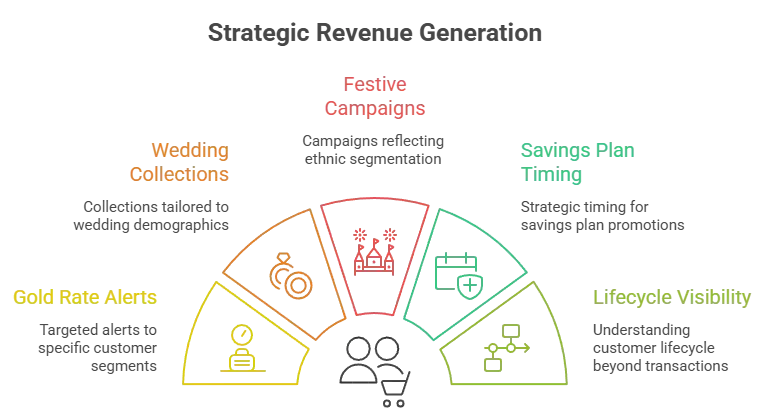
1. Gold Rate Alerts Shouldn’t Go to Everyone
Not every customer tracks gold daily.
But investment buyers do.
When gold drops and only that segment receives a timely alert, something shifts.
Instead of a passive “Seen” response, you start seeing:
- Direct replies asking for coin availability
- Walk-in visits within the same week
- Faster booking decisions
You’re no longer competing for attention — you’re responding to urgency that already exists.
Instead of spending on 5,000 conversations, you might activate 1,200 high-intent ones.
Lower cost per response.
Higher conversion per message.
More predictable weekly revenue movement.
2. Wedding Collections Should Target Wedding Demographics
Wedding jewellery is rarely an impulse purchase.
It’s planned.
When bridal collections go to everyone, most of the database ignores them.
But when families already in that life stage receive:
- Collection previews
- Appointment nudges
- Custom design suggestions
You see a different pattern:
Consultation bookings increase.
Store visits become warmer.
Decision cycles shorten.
The message doesn’t feel like advertising.
It feels like support during a planning phase.
And when a jewellery store becomes part of that planning conversation early, price sensitivity reduces and confidence increases.
That emotional shift directly impacts conversion rates — and often, average order value too.
3. Festive Campaigns Should Reflect Ethnic Segmentation
Festive buying is emotional.
When messaging aligns with cultural timing, response feels immediate and intentional.
A customer who typically purchases during Akshaya Tritiya may not respond to a general festive greeting in October. A family that shops during Onam may not engage with a Dhanteras-heavy campaign.
When one festive creative is sent to the entire database, response gets diluted.
But when messaging aligns with the festivals that actually matter to each segment, the behaviour changes.
Segmented campaigns often lead to:
Higher click-through rates.
Stronger catalogue browsing.
More specific product enquiries.
Because the buyer feels seen, not targeted.
That emotional relevance increases the likelihood of purchase without increasing message volume.
4. Savings Plan Timing
Introducing a savings scheme at the end of the month often results in hesitation.
Cash flow feels tighter.
But positioning the same plan at the beginning of the month changes behaviour.
Enrolment increases.
Customers ask about higher monthly commitments.
Long-term revenue visibility improves.
The offer didn’t change.
The financial readiness did.
When WhatsApp Business Platform is used to align communication with that readiness window, the difference shows up in steady enrolments — not sporadic spikes.
5. Lifecycle Visibility Beyond Transactions
Jewellery buying repeats across life moments.
If communication ends after purchase, the next sale depends on reacquisition.
But when customers receive timely anniversary reminders, milestone suggestions, or festival nudges aligned with past purchases, repeat buying feels natural.
You start noticing:
Returning customers without heavy discounts.
Higher average order value over time.
Referrals emerging organically.
Because the store stayed visible — not loud, just present.
Structured Visibility Compounds Over Time
When communication aligns with gold rate triggers, wedding planning windows, cultural festivals, and even monthly income cycles, something subtle shifts.
The jewellery store stops appearing only when it wants to sell.
It starts appearing when the customer is naturally ready to consider buying.
A well-implemented WhatsApp Business Platform makes this structure possible — ensuring the right segments receive the right message at the right moment.
Over time, that changes the economics of growth.
Fewer wasted conversations.
Warmer inbound replies.
More repeat purchases without heavy discounting.
Acquisition pressure reduces because existing customers return more easily.
And that happens for one simple reason — relevance builds trust.
When visibility feels timely instead of frequent, revenue doesn’t just increase once.
It compounds.
A Final Thought
If WhatsApp Business API feels expensive, it’s usually not because of the platform.
It’s because revenue and communication aren’t connected deliberately.
In jewellery, timing shapes demand.
When visibility aligns with decision windows, marketing stops feeling like spend — and starts behaving like infrastructure.
That’s the shift.
From broadcasting to designing.
From activity to alignment.If you’re looking to structure your WhatsApp Business Platform around clear segments, real triggers, and measurable revenue impact, the Wappbiz team can help you build it intentionally.