
Most D2C brands spend serious time optimising the first purchase.
Campaigns are planned.
Dashboards are tracked daily.
Cost per acquisition is constantly reviewed.
Creative is tested. Funnels are refined. Budgets are adjusted.
Acquisition brings customers in. Customer Retention is what sustains the business. Without retention, growth is fragile. The brands that scale sustainably understand this early.
They know that revenue doesn’t compound from one-time buyers. It compounds from relationships.
What I’ve seen repeatedly, though, is that far less time is spent on customer retention Not because teams don’t care about retention of customers.
But because acquisition feels urgent. Retention feels distant.
Why Retention Changes the Revenue Equation
Most D2C conversations focus on getting the next customer.
But the real leverage often sits with the ones you already have.
Research published in Harvard Business Review suggests that acquiring a new customer can cost 5 to 25 times more than retaining an existing one. Bain & Company has also found that increasing retention by just 5% can increase profits by 25% to 95%, depending on the industry.
Those numbers point to something simple:
Retention isn’t a marketing tactic. It’s a growth multiplier.
When there’s no defined retention plan, the first purchase stands alone.
- There’s no structured follow-up.
- No timing around replenishment.
- No reminder of value once the product is used.
Customers don’t necessarily leave.
They just move on.
And every new campaign works harder than it needs to because it isn’t building on past momentum.
Now look at the same acquisition cost differently.
If ₹1,000 brings a customer who buys once, that cost lives inside a single transaction.
If that customer returns twice more, the same ₹1,000 is now supporting three revenue events.
Nothing changed in ad spend.
But the economics improved.
Designing a Retention Journey in D2C
If retention is going to influence revenue, it can’t be left to occasional campaigns.
It needs a journey.
At a broad level, a retention strategy in D2C usually answers a few simple questions:
- What happens immediately after purchase?
- How does the customer get maximum value from the product?
- When are they likely to need it again?
- What keeps the brand relevant between purchases?
When these moments are mapped intentionally, repeat buying stops being accidental.
It becomes guided.
Some brands use email for this.
Some rely on SMS.
Some depend on remarketing ads.
Each has its place.
But in recent years, WhatsApp Business API has started playing a different role in this journey — especially in markets where it’s already part of daily communication.
When WhatsApp Business API is used intentionally, it stops being just a support channel or a broadcast tool.
It becomes the layer that connects post-purchase guidance, replenishment timing, and value-led follow-ups into one continuous conversation.
Designing the Retention Journey with WhatsApp Business
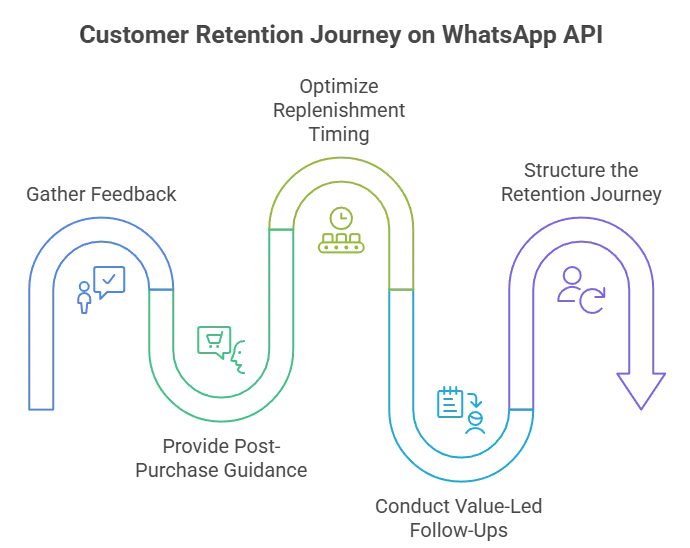
Retention doesn’t happen through one message.
It happens when the entire post-purchase experience is intentionally designed.
Below is how that journey typically unfolds in D2C and where WhatsApp Business API fits naturally.
1. Feedback as the Starting Point of Retention
Before reminders or repeat offers, there’s a more important step:
Understanding how the first experience went.
In D2C, feedback is often passive website reviews, marketplace ratings. But when collected intentionally and on time, it becomes the foundation of retention.
A simple post-delivery message:
“How would you rate your experience so far?”
does more than gather opinions.
It creates segmentation.
Positive responses signal readiness, these customers can be guided toward referrals, bundles, or repeat purchases.
Negative or neutral responses signal friction, these customers need support before any repurchase conversation.
Brands that skip this step treat everyone the same.
Brands that use feedback design different journeys based on experience.
On WhatsApp Business API, responses can trigger separate flows automatically, nurturing satisfied customers while resolving concerns in real time.
Retention of customers doesn’t begin with a reminder.
It begins with listening.
Because the second purchase depends on how the first one felt.
2. Post-Purchase Guidance
This matters for products where correct usage shapes results — skincare, supplements, wellness, electronics, fitness tools.
Most brands stop at order confirmation.
But once the product is opened, questions begin.
Am I using this correctly?
When will I see results?
Unanswered doubt reduces confidence.
And low confidence delays repeat purchases.
A simple WhatsApp follow-up with quick usage tips or FAQs removes that friction.
It’s not about pushing the next sale.
It’s about making sure the first one works.
Because confidence is what drives the second purchase.
3. Replenishment Timing That Feels Thoughtful
This works best for products with continuous usage — skincare, supplements, groceries, personal care, pet essentials.
In these categories, repeat purchase is built into the product.
Yet reminders often miss. Too early. Too late. Or completely generic.
The advantage comes from aligning communication with how long the product actually lasts.
If a supplement typically runs out in 30 days, that timeline shouldn’t stay internal.
It should decide when the customer hears from you next.
When timing reflects real usage, the message feels helpful instead of promotional.
“Running low? We’ve got you covered. Refill in two taps.”
No pressure. Just relevance.
Strategically, this requires two things:
- Clear understanding of average product lifespan
- Creative messaging around that window
On WhatsApp Business API, this can be automated and personalised without losing warmth.
And in continuous-use categories, repeat buying often depends less on persuasion and more on convenience.
If the refill is timely and easy, customers rarely look elsewhere.
4. Value-Led Follow-Ups
Discounts can trigger short-term spikes.
But they rarely build retention of customers on their own.
What works better over time is value-led communication:
- Care instructions
- Product pairings
- Best-use scenarios
- Customer stories
These messages don’t push a sale.
They deepen the experience.
They remind customers why they chose the brand in the first place.
When communication consistently adds value, the relationship shifts.
The brand stops feeling transactional.
It starts feeling supportive.
And loyalty grows not because of offers — but because of connection.
5. Structuring the Retention Journey
One of the biggest blind spots in retention of customers is inconsistency.
- A broadcast here.
- A festive offer there.
- A manual reminder when someone remembers.
It feels active.
But it isn’t designed.
Retention improves when communication follows a defined journey:
Day 1 — Order confirmation
Day 3–5 — Usage guidance
Mid-cycle — Value-led content
Pre-replenishment — Timely reminder
Post-repeat purchase — Appreciation and loyalty reinforcement
Each message builds on the last.
Nothing feels isolated.
When this structure is in place, WhatsApp becomes more than a messaging channel.
It becomes the layer that connects these moments consistently through automation, segmentation, and timely triggers.
The tool isn’t the strategy.
The journey is.
The tool simply makes it scalable.
The Brand Impact Most Teams Underestimate
Retention of customers is not only about revenue.
It shapes perception.
A brand that checks in thoughtfully feels premium.
A brand that disappears after delivery feels transactional.
Over time, that difference compounds:
- Higher lifetime value
- Stronger referrals
- Lower dependency on paid ads
- More predictable growth
Buyers don’t always remember ads.
They remember experiences.
Especially the ones that continue after payment.
Final Thought
Nothing is wrong with your checkout flow.
Nothing is wrong with your ads.
But if repeat purchases feel inconsistent, it’s worth looking at what happens after delivery.
Retention of customers is rarely about convincing someone twice.
It’s about staying relevant between purchases.
When WhatsApp Business API is structured intentionally, it keeps that continuity alive through timely guidance, thoughtful reminders, and value-led conversations.
And continuity is what turns one order into long-term revenue.
If you’re thinking about designing a clearer post-purchase journey for your brand, our team at Wappbiz can help you map and set it up in a way that feels structured, not overwhelming.
Sometimes growth doesn’t need more traffic.
It needs better follow-through.