
Communication in healthcare is the invisible thread that holds the patient journey together. From the moment a patient books an appointment to their post-discharge recovery, information needs to flow seamlessly. When it does, outcomes improve. When it doesn’t, the consequences can be life-altering.
Yet, despite advancements in medical technology, administrative workflows often remain stuck in the past. Phone lines are jammed, emails go unread, and patients are left waiting in the dark.
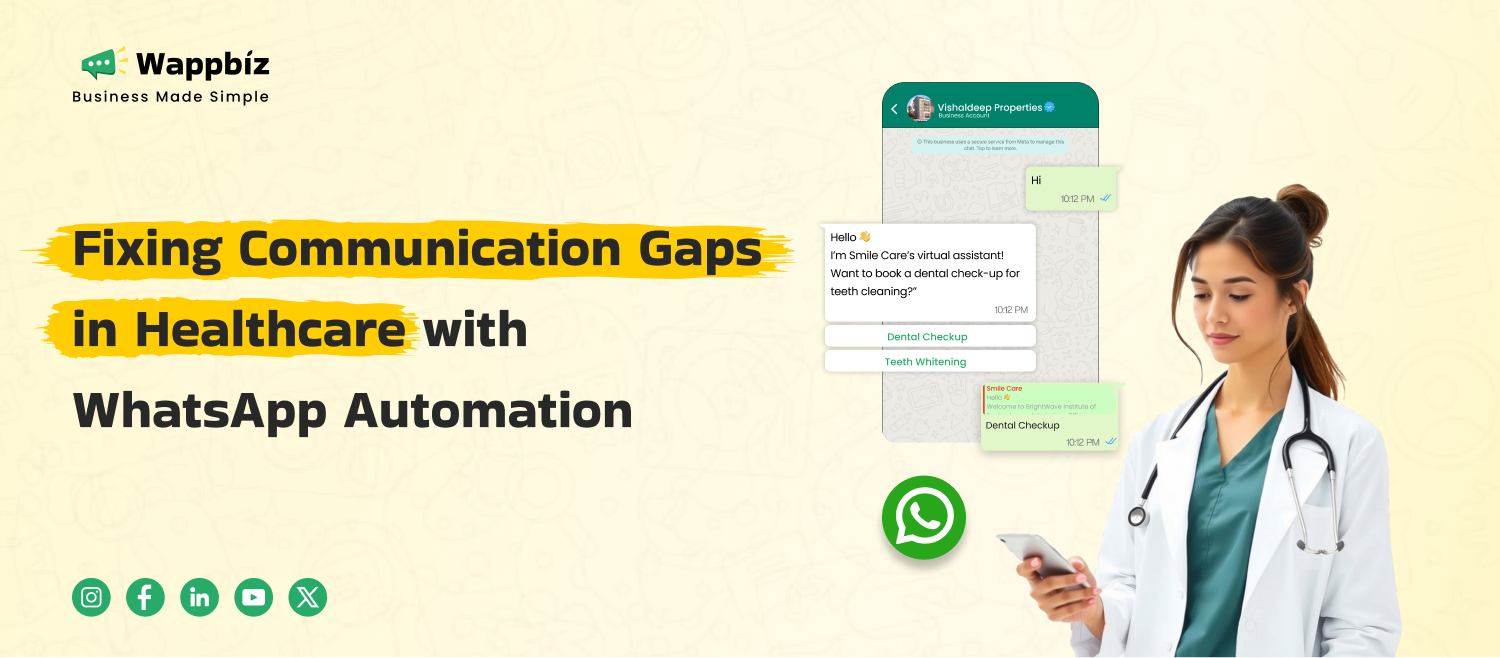
This is the definitive guide to identifying these cracks in the system and fixing them using modern automation to close the communication gap in healthcare.
Role of Communication in Delivering Quality Patient Care
When we ask the question, why is communication important in healthcare, the answer goes far beyond simple courtesy. In the medical field, communication is the backbone of patient safety, operational efficiency, and successful clinical outcomes.
A breakdown in communication doesn’t just result in a lost customer; it can result in a medical error. Conversely, effective communication in healthcare acts as a powerful preventative medicine. Here is why prioritizing this connection is non-negotiable for modern providers:
Builds Trust Between Patients and Healthcare Professionals
Trust is the currency of healthcare. Patients are often in a vulnerable state, dealing with pain or uncertainty. When a Healthcare Professionals communicates proactively whether through a timely update on wait times or a clear explanation of a diagnosis it reduces anxiety. This transparency builds a “therapeutic alliance,” making patients feel safe, heard, and more willing to share critical health details that aid diagnosis.
Reduces Medical Errors and Misdiagnosis
Miscommunication is a leading cause of preventable medical errors. If a patient misunderstands a verbal instruction about fasting or medication dosage, the consequences can be severe. By moving towards digital, documented communication (like WhatsApp), healthcare professionals create a clear reference trail. This clarity ensures that instructions are received, read, and understood, significantly lowering the risk of accidental non-compliance.
Improves Treatment Adherence and Outcomes
A prescription is only effective if the patient takes it. Studies indicate that a significant percentage of treatment failures stem from patients forgetting their medication or stopping early due to a lack of follow-up. Continuous communication such as automated reminders or “check-in” messages bridges the gap between the clinic and the home, ensuring patients stick to their recovery plans.
Enhances Patient Satisfaction and Experience
In today’s digital age, Patient Experience (PX) defines a hospital’s reputation. A patient might tolerate a delay, but they will not tolerate being ignored. Keeping patients in the loop regarding appointments, reports, and procedures transforms their experience from stressful to seamless. Satisfied patients become loyal advocates, driving positive reviews and referrals for your practice.
The Reality Check—Communication Gaps Healthcare Can’t Ignore
While most clinics strive for perfection, the operational reality is often chaotic. A study by the National Institutes of Health (NIH) suggests that 40-80% of medical information provided by healthcare professionals is forgotten immediately by patients. Worse, almost half of what is remembered is incorrect.
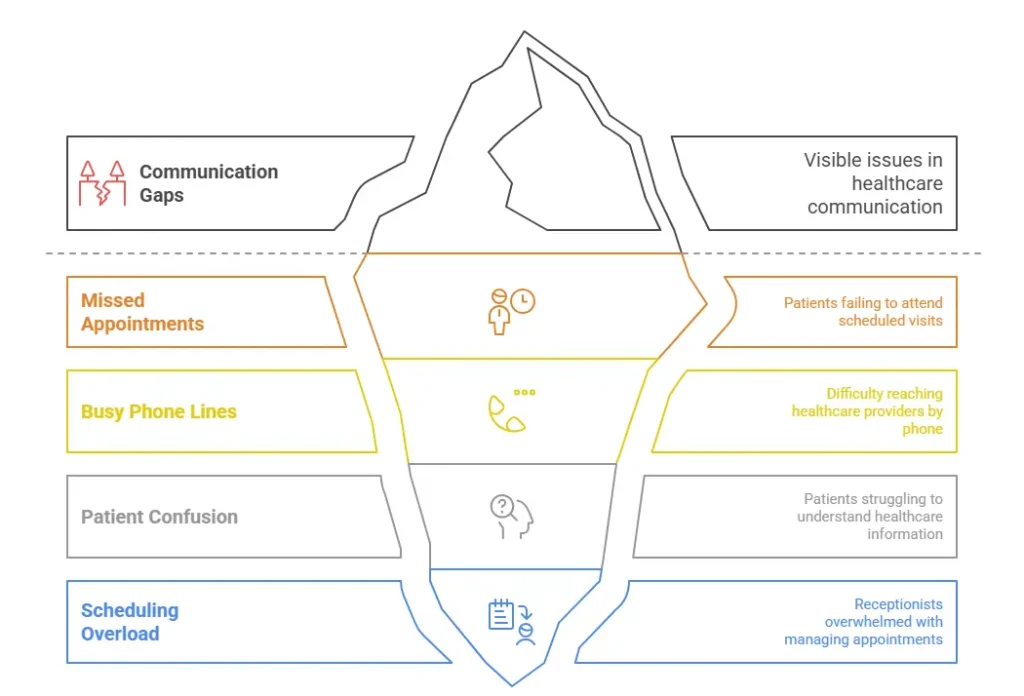
These aren’t just statistics; they represent real leaks in your patient pipeline. Here are the four biggest communication gaps crippling modern practices:
The No-Show Problem That Disrupts Care
Missed appointments are the silent killer of clinic revenue. Industry data shows that the average “No-Show” rate hovers around 23% globally. When a patient simply forgets their 10:00 AM slot, it triggers a chain reaction: the doctor sits idle, revenue is lost, and a sick patient waiting for a slot next week is delayed unnecessarily. Manual confirmation calls are often ignored (or marked as spam), leaving the care team in the dark until the very last minute.
The Busy-Line Issue That Blocks Patient Access
How many patients give up because they hear a busy tone? Research indicates that 42% of calls to medical practices go unanswered during business hours. A patient in pain will not call back five times; they will simply call the next clinic on Google Maps. If your front desk is overwhelmed with routine queries like “What time are you open?”, they are likely missing the urgent, high-value calls that matter.
The Information Gap That Confuses Patients
Medical instructions are complex. A quick verbal instruction “Take this twice a day after food, but not with milk” is easy to misunderstand once the patient leaves the consultation room. Without in written or a digital reference, patients resort to “Dr. Google,” often finding incorrect advice that complicates their recovery. This information gap leads to poor medication adherence and preventable readmissions.
The Manual Scheduling Slowdown That Wastes Time
In many hospitals, booking an appointment still involves a receptionist flipping through a physical register or an Excel sheet while the patient waits on hold. This manual friction adds unnecessary minutes to every interaction. It forces highly trained staff to act as data entry clerks rather than focusing on patient care. In an era of instant booking apps, asking a patient to “hold on while I check the diary” is the fastest way to damage the patient experience.
Why Traditional Channels Fail & Why WhatsApp is the Cure
To fix the communication gap, many clinics resort to SMS blasts or email newsletters. But be honest, when was the last time you read a generic SMS from a business?
Traditional channels are failing because they are noisy and impersonal. Emails get buried in spam folders (with an open rate of barely 20%), and phone calls are often screened as “Unknown Numbers.” In healthcare, where a missed message can mean a missed diagnosis, these odds are not good enough.
This is why WhatsApp is becoming the gold standard for patient engagement.
The 98% Open Rate That Always Gets Noticed
The numbers don’t lie. WhatsApp boasts a staggering 98% open rate, with most messages read within 3 minutes of delivery. Unlike an email that might sit unread for days, a WhatsApp notification demands attention. For urgent updates like “Your MRI report is ready” or “Dr. Sharma is running 15 minutes late” this speed is crucial. It ensures the message isn’t just sent; it is seen.
Multilingual Support That Reaches Every Patient
Healthcare serves everyone, regardless of language proficiency. A significant communication gap occurs when a patient cannot understand the English instructions given by a hospital. WhatsApp breaks this barrier. Healthcare professionals can set up automated flows that ask: “Preferred Language? English, Hindi, or Marathi?” By delivering care instructions in the patient’s native tongue, you drastically reduce confusion and improve comfort levels for elderly or non-English speaking patients.
The Verified “Blue Tick” Experience That Builds Instant Trust
In an age of medical misinformation and spam calls, patients are skeptical of unknown numbers. Using the official WhatsApp Business API (via platforms like WappBiz) allows your hospital or clinic to apply for the coveted Blue Tick Verification. When a patient receives a message from a verified profile, they know it is official medical advice, not a scam. This instant credibility is vital for sensitive communications like billing, test results, or post-surgery check-ins.
5 Ways WhatsApp Automation Can Improve Communication in Healthcare
Knowing why we need to communicate is easy; knowing how to do it at scale is the challenge.
You cannot expect your front-desk staff to manually text 500 patients a day. Instead, you need to set up automated workflows that trigger based on patient actions. Here are five high-impact strategies to close the communication gap using WhatsApp automation:
1. Automating Appointment Reminders & Confirmations
The average “No-Show” occurs because life gets in the way. A simple SMS is easily missed, but a WhatsApp message requires interaction.
- The Strategy: Set up a “24-Hour Reminder” flow.
- How it works: One day before the visit, the patient receives a message: “Hi Rahul, your appointment with Dr. Mehta is tomorrow at 10:00 AM. Please tap ‘Confirm’ or ‘Reschedule’.”
- The Result: Patients can confirm with one tap. If they need to reschedule, they do it instantly without clogging your phone lines, freeing up the slot for someone else.
2. Sending Pre-visit Checklists (Documents, Fasting rules)
Nothing slows down a clinic more than a patient arriving unprepared—forgetting their insurance card or eating breakfast before a fasting blood test.
- The Strategy: Automated “Prep-Packets.”
- How it works: The moment an appointment is booked, the chatbot sends a relevant checklist.
- For MRI: “Please remove all jewelry and wear loose clothing.”
- For Blood Test: “Remember to fast for 12 hours. Drink only water.”
- For Admission: “Please bring your Aadhar card and previous reports.”
3. Real-time OPD Queue Updates (Reducing Waiting Room Anxiety)
Waiting rooms are stress-filled environments. Patients often feel trapped, afraid to step out for a coffee or a breath of fresh air in case they miss their turn.
- The Strategy: The “Live Token” System.
- How it works: Instead of making patients stare at a screen on the wall, send updates to their phone. “Current Token: 15. Your Token: 22. Estimated Wait Time: 40 Minutes.”
- The Result: Patients are free to wait in the cafeteria or their car, reducing crowding and anxiety in the lobby.
4. Pharmacy Alerts: Prescription Refills & Dosage Reminders
For chronic patients (diabetes, hypertension), medication adherence is a lifeline. Yet, adherence rates drop significantly after the first six months.
- The Strategy: The “Smart Refill” Nudge.
- How it works: Connect your pharmacy inventory to WhatsApp. If a patient buys a 30-day strip of medicine, the system automatically messages them on Day 25: “Hi Priya, your medication is running low. Would you like to order a refill for home delivery?”
5. Post-Discharge Care & Feedback Loops
The most dangerous time for a patient is the first 48 hours after leaving the hospital. Confusion about home care leads to readmissions.
- The Strategy: The “Care Companion” Sequence.
- How it works: After discharge, trigger a gentle check-in sequence.
- Day 1: “Hope you are resting well. Here is a PDF guide on wound care.”
- Day 3: “Do you have any fever or pain? Tap Yes/No.”
- Day 7: “How was your experience with us? Rate us 1-5.”
How to Improve Communication in Healthcare with WappBiz
Understanding the strategy is one thing; implementing it without hiring an IT team is another.
This is where WappBiz bridges the gap. Built specifically for high-volume communication, WappBiz simplifies the technical complexity of the WhatsApp Business API, allowing healthcare professional to focus on what matters most: patient care.
Here is how WappBiz solves the “Execution Gap” for hospitals and clinics:
Zero-Code Setup: Deploy Pre-built Appointment Flows in Minutes
You don’t need a software engineer to set up your patient communication. WappBiz offers a No-Code Drag-and-Drop Flow Builder.
Simply drag blocks to create a conversation. Want to add a “Book Appointment” button? Drag it. Want to ask for the “Department”? Drop it.
- Templates: Use pre-approved healthcare templates for appointment reminders and report delivery, ensuring you go live in hours, not months.
Unified Data: Seamless Integration with Your Hospital CRM
A chatbot that doesn’t talk to your patient database is useless. WappBiz integrates seamlessly with your existing Hospital Management Information System (HMIS) or CRM (like Salesforce, HubSpot, or custom tools).
- The Benefit: When a patient confirms an appointment on WhatsApp, WappBiz instantly updates your doctor’s calendar. No manual data entry, no double-booking errors.
24/7 Availability for FAQs While Staff Sleeps
Your front desk closes at 8 PM, but patient anxiety doesn’t. WappBiz’s AI-Powered Chatbots act as your “Night Shift” reception team. They can answer Level-1 queries instantly:
- “Is Dr. Rao available tomorrow?”
- “What is the cost of a CBC test?”
- “Where is the clinic location?” By automating these routine questions, you ensure patients feel heard even at 2 AM, preventing them from looking for another provider.
Conclusion
Patients today expect the same speed from their doctor as they do from their favourite apps. If you are hard to reach, they won’t wait until they will find another healthcare professional.
WappBiz turns this challenge into your advantage. By automating reminders, queue updates, and FAQs, we help you eliminate administrative chaos and focus on what truly matters: patient care.
Your patients are already on WhatsApp. It’s time you met them there.Ready to modernize your practice? [Book a Free WappBiz Demo] and see how simple it is to build an “Always-On” healthcare experience.