
If you’re in real estate, this situation will feel familiar.
Your team receives enquiries on WhatsApp from ads, property portals, exhibitions, and referrals. Conversations begin. Brochures and listings are shared. Follow-ups are made.
Yet a few days later, the same questions keep coming up internally:
- Which leads are actually serious?
- Why did some WhatsApp conversations suddenly go cold?
- Why are we talking to many buyers but converting so few?
In most cases, the problem isn’t lead volume or team effort. It’s how the initial WhatsApp conversation is structured, often driven by a real estate chatbot that isn’t aligned with how buyers explore, evaluate, and make decisions.
The Real Problem Most Teams Face
What I’ve consistently seen across developers isn’t a lack of automation; it’s poorly designed automation. Most of these flows are built around collecting information quickly, not around making the conversation comfortable for the buyer.
The result often looks like buyers messaging casually, getting pushed into form-like questions too early, and receiving calls before their intent is clear.
For example, a common opening question is:
“What is your budget?”
A far better start is:
“Are you exploring options or planning to buy soon?”
From the buyer’s side, the interaction feels rushed and impersonal.
From the sales side, it still doesn’t create real clarity.
This is where a real estate chatbot, when designed around buyer comfort and timing, quietly makes a meaningful difference.
A Chatbot’s Real Job
From a growth perspective, a chatbot in real estate is not about automation for its own sake. It’s about timing.
Buyer psychology on WhatsApp is simple:
- Early-stage buyers want information, not calls
- Serious buyers want clarity, not repetition
- Most buyers want control over when sales enters the picture
An effective chatbot respects this and adapts accordingly.
What an Ideal Chatbot Flow Looks Like in Practice

1. Start Where the Buyer Is.
Many chatbots still open with:
“Please share your name, number, budget, and location.”
This feels transactional and leads to drop-offs.
A better approach starts with intent:
- “Looking to buy soon”
- “Just exploring options”
- “Investment purpose”
This single step sets the tone and decides how the conversation should progress.
2. Qualification Should Feel Like a Conversation
Buyers don’t mind answering questions, they mind being overwhelmed. On WhatsApp, conversations work best when each question feels like a natural next step, not a form being filled.
A simple, effective flow usually looks like this:
- Start by understanding intent:
“What’s your primary reason for exploring a home right now?”
(Options: Own use / Investment / Rental income)
- Move to location context:
“Which area are you currently considering?”
(Options: Select area / Open to suggestions)
- Narrow down home preference:
“What kind of home are you looking for?”
(Options: 1 BHK / 2 BHK / 3 BHK / Villa / Plot)
- Introduce budget gently:
“Which budget range would you be most comfortable exploring?”
(Options: Under ₹75L / ₹75L–₹1Cr / Above ₹1Cr)
- Ask about timeline once interest is clearer:
“When are you ideally planning to move or invest?”
(Options: Immediately / 6–12 months / Just exploring)
Each question gives the buyer clear, low-effort choices, making the interaction feel guided and respectful while still giving sales teams the clarity they need to act.
3. Treat Site Visits as the Real Conversion Point
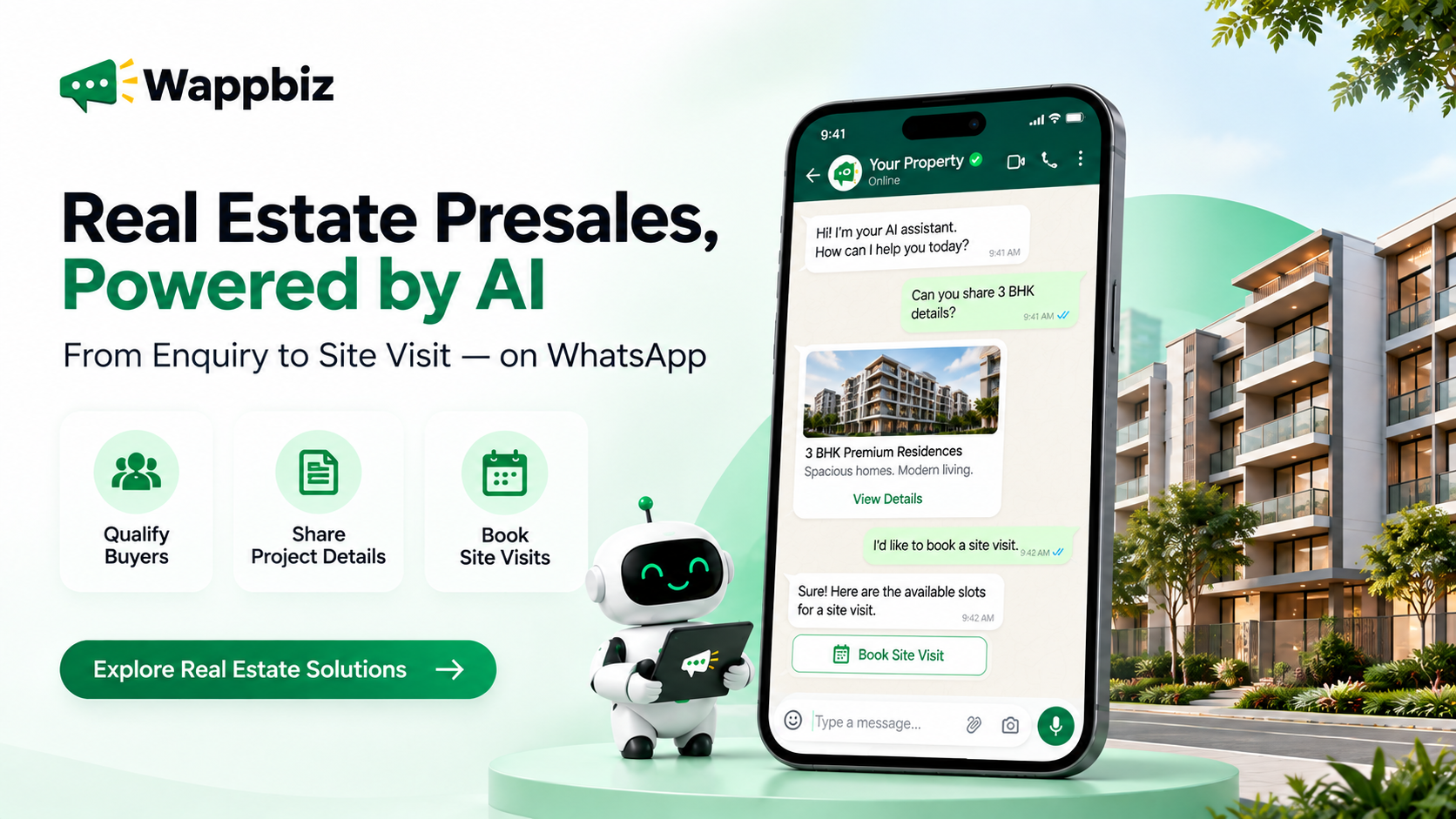
In real estate, a lead is only a starting point, the real conversion is a site visit. Once the chatbot has qualified intent, understood budget comfort, and identified near-term interest, it can naturally move the conversation forward.
At that stage, a prompt like: “Would you like to schedule a site visit to explore this project in person?” feels timely and relevant.
At this point, the chatbot simply handles the logistics, suggesting available dates and time slots, sharing the location pin, confirming the visit, and sending reminders later if needed. By taking care of these steps automatically, it reduces back-and-forth for both sides and ensures the site visit actually happens. When done at the right moment, this feels organised and supportive, not pushy.
4. Financing Questions Reveal Serious Intent
One of the most telling questions a chatbot can ask is:
“Do you need help with home loan options?”
This question serves two purposes. For buyers, it feels helpful and relevant rather than sales-driven. For sales teams, it’s a strong signal of purchase readiness. Buyers who engage here are usually thinking beyond exploration and closer to decision-making, which helps teams prioritise follow-ups with far more confidence, without guesswork.
5. Let Intent Scoring Happen Quietly
To the buyer, the conversation should feel simple and natural. Behind the scenes, it should be far more structured.
Based on how a buyer responds, the chatbot can automatically tag leads, for example, someone who selects “looking to buy soon” can be marked as a warm lead, while someone just exploring can be tagged differently.
This quiet intent scoring helps separate casual enquiries from serious prospects, so sales teams spend time where it actually matters.
6. Use Rich Media to Keep Buyers Engaged
A chatbot shouldn’t rely only on text. Sharing useful media at the right moment helps buyers understand the project faster and keeps the conversation moving naturally.
Short project videos, brochures, floor plans, or walkthrough clips allow buyers to explore at their own pace. This improves engagement, reduces back-and-forth questions, and leads to more focused conversations during follow-ups.
A good chatbot doesn’t try to sound smart. It focuses on responding at the right time, respecting buyer comfort, and moving the conversation forward based on intent. When that happens, WhatsApp stops being a noisy inbox and starts becoming a predictable growth channel.
If you’d like to see how builders are using WhatsApp chatbots to qualify leads, book site visits, and simplify follow-ups, you can get in touch with the Wappbiz team to explore how these flows work in practice. For more practical thinking on digital-first real estate growth and buyer engagement, follow Wappbiz.